Jackery Explorer 2000 v2 Portable Power Station 2042Wh Review (2026)
Updated September 14, 2026 · Research-based review
Our verdict
The Jackery Explorer 2000 v2 fits car campers or small groups who need multi-day power for a fridge, cooking appliances and several devices. Its strength is high capacity in a lighter, more compact body than older 2000Wh-class units, and its trade-off is a heavy, costly unit that overshoots light device charging needs.
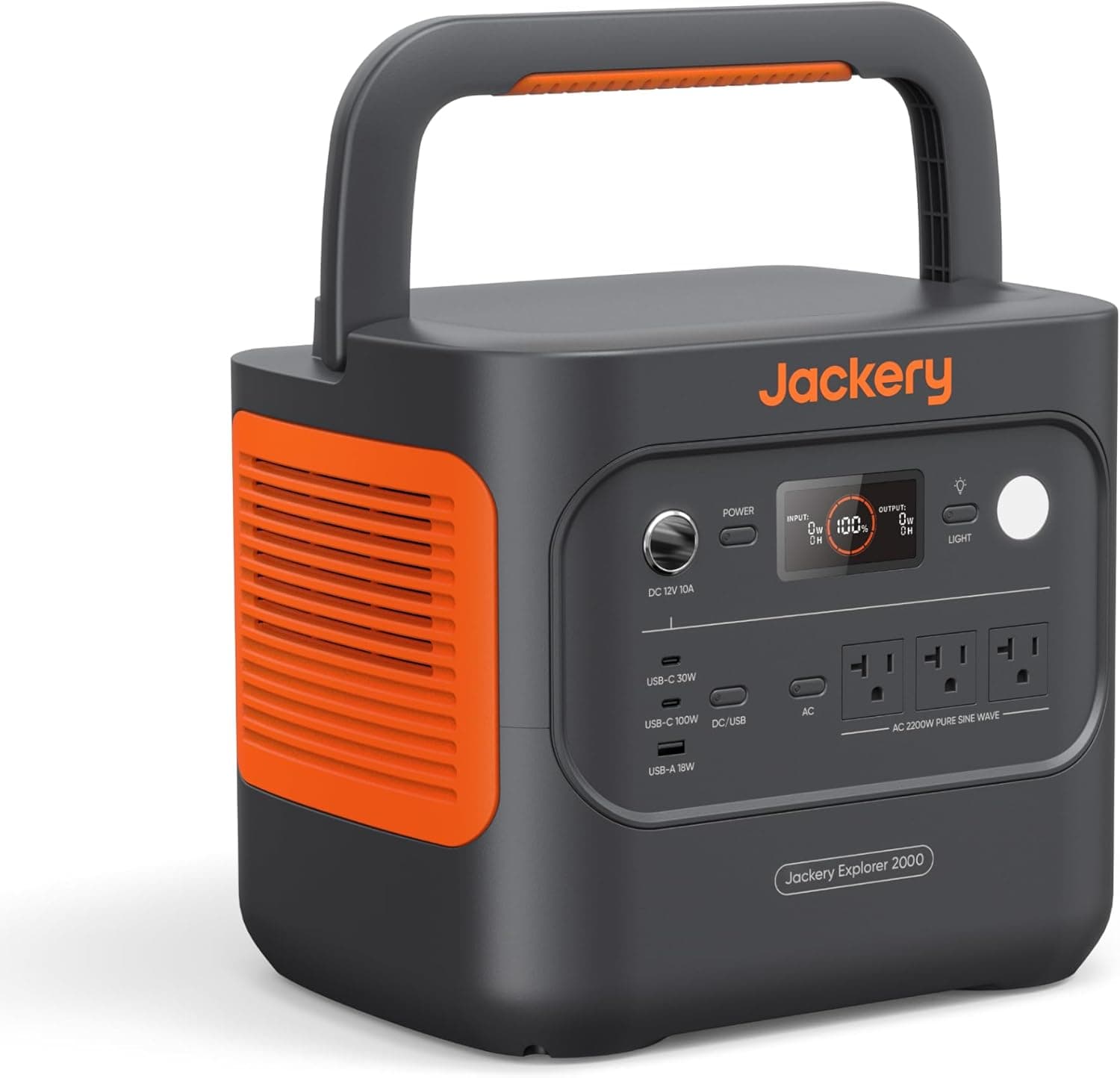
Jackery Explorer 2000 v2 packs 2042Wh, a large power station for extended car camping with fridges, cooking appliances and laptops.
Price range: $$$ (Premium)
What we liked
- + 2042Wh capacity can run a camp fridge for days between charges
- + High output suits kettles, induction cookers and power tools
- + Large capacity supports a small group camp from a single unit
Trade-offs
- - Heavy unit is hard to move alone in and out of the vehicle
- - Expensive investment for campers who only charge phones and lights
Who this power station is for
The Explorer 2000 v2 is built for extended car camping trips or small group sites where power demand adds up: a fridge running continuously, plus a kettle or induction hob at meal times, plus laptops and phones throughout the day. Jackery states the unit is 41 percent lighter and 34 percent smaller than typical 2kWh-class LiFePO4 power stations, which matters if you are moving it in and out of a vehicle repeatedly rather than setting it up once at a fixed camp. It weighs about 39.5 pounds according to Jackery, still substantial but more manageable than older large stations. Solo campers who only need to charge phones and run lights are paying for far more capacity than they will use.
Battery, output and charging specs
Jackery lists a 2042Wh capacity built on a 10 year rated LiFePO4 battery using what Jackery calls CTB, or cell-to-body, technology, alongside EV-grade LFP cells for long-term durability. Output totals 2200W across three AC outlets, with a listed peak output of 4400W for appliances with a higher startup draw. Charging options include AC fast charging that Jackery states can reach full in about 2 hours, an emergency super charge mode around 1.7 hours, and a quieter charging mode near 30 decibels that takes about 5 hours. Dual solar inputs support up to 400W of solar charging, useful for multi-day trips without shore power. Ports include USB-C PD 100W, USB-A, and a 12V car outlet alongside the AC sockets.
Living with it at camp
In daily use, this station is best planned as your camp's central power hub rather than something you carry far from the vehicle, given its weight. Jackery includes an automatic UPS function with a 20 millisecond switchover, which is mainly relevant for home backup use but also means camp electronics see minimal interruption if you swap input sources. Wi-Fi and Bluetooth connectivity let you monitor charge level and output settings from the Jackery app rather than walking back to the unit. Jackery rates operating noise under 30 decibels, quiet enough to run overnight near a tent without disturbing sleep. As with any lithium station, keep it shaded from direct sun and avoid deep-discharging it repeatedly to protect long-term battery health.
How it compares with other power stations
Within the same capacity class, the DJI Power 2000 offers a similar roughly 2048Wh capacity with a higher 3000W rated output, while the BLUETTI AC180 and DJI Power 1000 both sit at lower capacity and lower weight for campers who do not need multi-day runtime for a fridge. The EcoFlow RIVER 2 Pro and RIVER 2 undercut this unit significantly on both capacity and price, aimed at lighter device charging rather than appliance-heavy trips. Jackery's advantage in this comparison is the combination of high capacity with a notably lighter, more compact body than earlier 2000Wh-class stations, which narrows the usual trade-off between capacity and portability.
Verdict and who should pick something else
This station earns our score of 8.6 out of 10 for packing 2042Wh and 2200W output into a body lighter and smaller than typical 2000Wh-class competitors, making it a strong pick for multi-day car camping with a fridge and cooking appliances. Choose it if your trips regularly run several power-hungry devices for days at a time. Skip it if you only need to charge phones and run small lights, since a smaller, cheaper station like the EcoFlow RIVER 2 will cover that need without the added weight and cost. Campers who want even more headroom should compare it against the DJI Power 2000 for its higher rated output.
Frequently asked questions
How much does the Explorer 2000 v2 weigh?
Jackery lists it at about 39.5 pounds, lighter than typical 2000Wh-class power stations according to the manufacturer.
How fast does it recharge?
Jackery states AC fast charging reaches full in about 2 hours, with an emergency super charge mode around 1.7 hours and a quiet mode near 5 hours.
Can it be charged with solar panels?
Yes, it supports dual solar inputs up to 400W total, according to Jackery's specifications.
Is it too much power station for a solo camper?
For phone and light charging alone, yes. A smaller station covers that need for less weight and cost, and this unit is better suited to running a fridge and appliances over several days.
Prices change often, so check the current price and availability on Amazon.
Check price on AmazonCar Camp Picks may earn a commission from the link above.