Sea to Summit Camp Self-Inflating Foam Mat Regular Review (2026)
Updated September 14, 2026 · Research-based review
Our verdict
The Camp Regular is Sea to Summit's entry self-inflating mat, a good pick for campers who want brand-name build quality without paying for the thicker Plus or Comfort tiers. Quick setup and solid warmth for the price are the main strengths, while its thinner profile means side sleepers may notice the ground more than on the Plus.
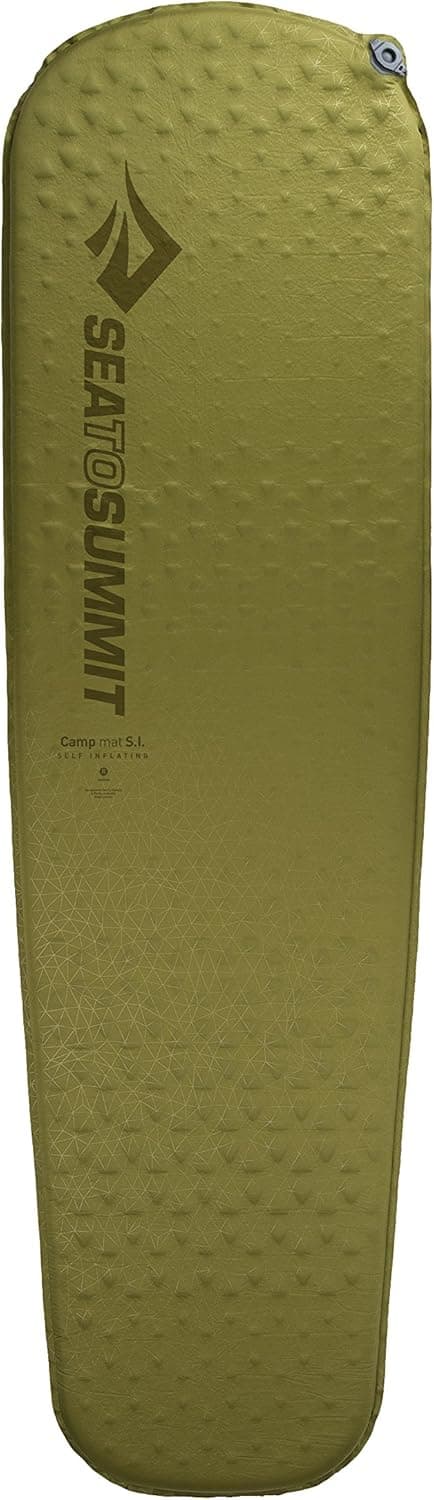
Sea to Summit Camp self-inflating foam mat in regular, the entry model in the brand's self-inflating pad range.
Price range: $$$ (Premium)
What we liked
- + Entry model brings Sea to Summit quality at a lower cost than Plus versions
- + Self-inflating foam sets up quickly with minimal pumping
- + Foam core adds warmth over cold ground compared with thin air pads
Trade-offs
- - Thinner than the Plus and Comfort models, so side sleepers may feel the floor
- - Regular size may feel short for very tall campers
Who the entry-tier Camp mat suits
The Camp Regular sits at the bottom of Sea to Summit's self-inflating mat range, aimed at campers who want the brand's foam-and-fabric construction without stepping up to the pricier Plus or Comfort lines. Its listed footprint of about 72 by 20 inches suits an average-height adult in a tent or the back of an SUV, though very tall campers may find it comes up short at the feet. It works best for back sleepers and casual car campers who do not need maximum cushioning, since the thinner foam core gives less give than the Plus version. Families outfitting multiple sleepers on a budget, or anyone who wants a reliable spare mat for guests, are a natural fit. Side sleepers and anyone camping regularly on rocky or uneven ground should weigh the thicker Plus model instead, since the extra loft there does more to smooth out the surface underneath.
Specs and what they add up to
Sea to Summit lists the Regular Camp mat with a thickness of roughly 4 cm (about 1.5 to 2 inches depending on the tapered profile) and an R-value around 4.2 under ASTM F3340 testing, enough insulation for most three-season camping without the added bulk of the Plus tier. Packed weight lands under 2 pounds, and it rolls down to roughly 12 by 6 by 6 inches, small enough to stash in a duffel alongside other gear. Construction uses a 75D recycled polyester face fabric with TPU lamination over a polyurethane foam core, the same fabric family used across the Camp lineup, so durability is in line with the brand's other self-inflating mats even at this lower price point. The XPEL valve system speeds up both inflation and rolldown compared with older twist valves, and the mat's Air Zone construction shapes the foam for slightly more support under hips and shoulders.
Living with it on a trip
Setup follows the usual self-inflating routine: open the valve, let the foam draw air in on its own, then add a handful of breaths to bring it up to full firmness before sealing the valve. Packing it away pushes the air back out, and the side-loading stuff sack included with the mat is sized to hold it once rolled. Because the foam core is thinner than on the Plus model, campers on rocky or root-covered ground may want a footprint or tarp underneath to protect the fabric, a common practice with lower-profile self-inflating mats generally. Sea to Summit backs the mat with a return window after purchase and lists formal warranty terms on its own site, worth checking before a big trip if the mat will see heavy use.
How it stacks up against pricier options
The clearest step-up comparison is Sea to Summit's own Camp Plus Regular, which adds roughly double the loft and a noticeably higher R-value for campers who find this entry mat too thin on hard ground. The Klymit Insulated Double V Two-Person Sleeping Pad takes a different approach entirely, trading the self-inflating foam core for an insulated air-chamber pad wide enough for two, which suits couples more than the single-width Camp Regular. Within its own price tier the Camp Regular holds up reasonably well on value, since it carries Sea to Summit's fabric and valve quality down to a lower thickness rather than cutting corners on materials, but buyers who sleep cold or on their side should budget for the Plus tier instead of assuming this mat will match it.
Verdict and who should size up
As an entry point into self-inflating mats, the Camp Regular earns its score mostly on value and reasonable build quality rather than outright comfort, matching its 7.8 out of 10 result. It makes sense for casual car campers, back sleepers, and anyone equipping a group on a budget. Side sleepers, campers over about six feet tall, and anyone expecting near-freezing nights should look at the Camp Plus or Comfort Plus tiers instead, since the thinner foam here is the clearest limiting factor. Buyers deciding between this and the Large-format Camp Plus should also weigh how much floor space their tent or vehicle actually has before sizing up.
Frequently asked questions
How thick is the Camp Regular mat?
Sea to Summit lists it at roughly 4 cm of loft, thinner than the Camp Plus tier, so side sleepers may feel more of the ground underneath than on a thicker pad.
Is it warm enough for cold weather camping?
Its R-value of around 4.2 under ASTM F3340 testing covers most three-season use, but for near-freezing or colder ground a thicker pad like the Camp Plus is the safer choice.
Does it come with a repair kit or storage bag?
It ships with a side-loading stuff sack sized for the rolled mat; check the current listing for what repair materials are included before a trip.
How does it compare with the Camp Plus version?
The Camp Plus adds roughly double the thickness and a higher R-value for more cushioning and warmth, at extra weight and packed size, while the Regular keeps things lighter and less bulky.
Prices change often, so check the current price and availability on Amazon.
Check price on AmazonCar Camp Picks may earn a commission from the link above.